Special conditions in a contract of sale: a Victorian buyer's guide
5
min read
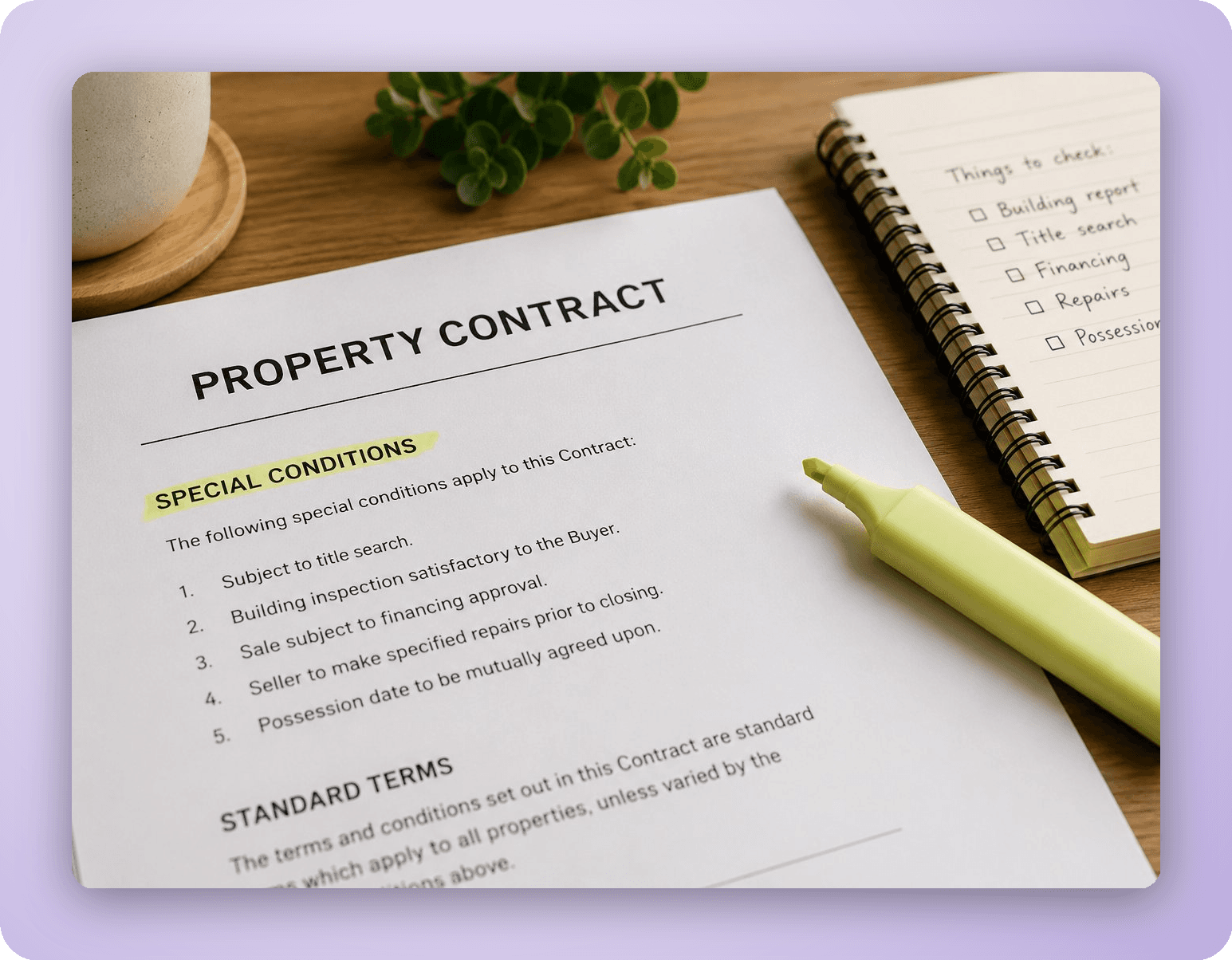
You've found a property, the agent has handed you a contract, and buried in the middle somewhere is a section called "special conditions".
In Victoria, special conditions can give you the right to walk away if your finance falls through, the right to a building inspection, or the right to withdraw if certain checks come back badly. They can also do the opposite: increase your liability if settlement is delayed, limit the vendor's repair obligations, or strip out protections you'd normally rely on. The wording matters, and so does the order in which the contract reads them.
What special conditions actually are
A Victorian contract of sale has three layers. The particulars of sale record the basic facts: price, parties, deposit, settlement date. The general conditions are the standard clauses published in the LIV/REIV Contract of Sale of Land, last updated in September 2025. The special conditions are the bespoke clauses added on top, drafted by the vendor's lawyer or conveyancer to fit this specific property and this specific sale.
Where a special condition contradicts a general condition, the special condition wins. That's why a single paragraph at the back of the contract can quietly override pages of standard protection.
For more on how the document fits together, see our guide to what's in a contract of sale and our conveyancing glossary.
Special conditions buyers commonly ask for
Some special conditions exist to protect you. These are typically negotiated before you sign, especially in a private sale.
Subject to finance
A finance condition makes the contract conditional on you obtaining unconditional loan approval by a specific date, on terms acceptable to you. If approval doesn't come through, you can end the contract by written notice and recover your deposit. We've covered this clause in detail in our subject to finance guide.
A few things to check in the drafting:
The date is realistic. Depending on how advanced your financing discussions are, you may need more or less time to get a final decision.
The lender named (or "a lender of the purchaser's choice") matches who you're actually applying to.
The amount and terms reflect what you need to borrow.
Finance conditions are rare at auction. A property bought under the hammer is generally an unconditional purchase, which is one of the reasons pre-auction due diligence matters so much.
Subject to building and pest inspection
In Victoria, there's no automatic statutory right to a building inspection before settlement. If you want one, it needs to be a special condition (unless you arrange for one before you make an offer).
A typical building inspection clause gives you a set number of days to obtain a report from a registered building practitioner and to end the contract if the report identifies major structural defects. The wording is everything: a clause that lets you walk away for "any" issue reads very differently from one that requires "major structural defects" or "defects costing more than $X to repair".
Subject to sale of another property
If your purchase depends on selling your current home, you can ask for a clause that ends the contract if your sale doesn't proceed. Vendors are often reluctant to accept these, but they're worth asking for if your circumstances require it.
Due diligence clauses
A broader due diligence clause lets you make searches and enquiries (titles, planning, building permits, owners corporation records) and end the contract if anything unsatisfactory comes back. These are more common in commercial sales but appear in residential contracts where there's known complexity.
Another version of this is a contract review special condition, that allows you a certain number of days to get legal advice on the contract. If you are in this position, reach out to us for a free, same-day contract review.
Special conditions the vendor adds
Vendors and their lawyers also add special conditions, and these usually run in the vendor's favour. The most common ones to look for:
Settlement extension rights. Clauses that let the vendor extend settlement without penalty. Compare these against the timeframes in the general conditions.
Repair and condition exclusions. Clauses that say the property is sold "as is" or that exclude specific repair obligations under general condition 24 (condition of property). These are common and often reasonable, but you should know what you're agreeing to.
Owners corporation, GST, or development clauses. If the property is part of a strata or development site, you'll often see clauses dealing with owners corporation rules, GST treatment under the margin scheme, or vendor's rights during a planning process.
Land tax adjustment clauses. For contracts entered on or after 1 January 2024, section 10G of the Sale of Land Act 1962 (Vic) generally prohibits a vendor recovering land tax from a purchaser where the sale price is below a threshold amount. As at 1 January 2025 the threshold is $10.4 million, indexed annually. For most residential buyers this means a land tax adjustment clause has no effect. If you see one, that's worth flagging to your lawyer.
The traps buyers miss
A few specific things to watch out for in special conditions:
"Diligent" finance applications. Some finance clauses require you to apply "diligently" or "promptly" and to provide evidence on request. If the vendor disputes whether you applied properly, the clause can be argued either way. Keep records of every application.
Deemed satisfaction. Watch for clauses that say a condition is "deemed satisfied" unless you give written notice within a specific number of days. Miss the notice window, and you've lost the protection.
Modifications to section 27 (early deposit release). Section 27 of the Sale of Land Act 1962 (Vic) sets out a statutory process by which a vendor can apply for early release of the deposit. In GLP Batesford Holdings Pty Ltd v 68 Bridge Road Land Pty Ltd [2022] VSC 614, the Supreme Court found that a special condition attempting to modify the statutory section 27 process in a way that reduces the purchaser's rights is ineffective. If you see a special condition trying to alter how early deposit release works, treat it with caution.
Conflicts with general conditions. Because special conditions prevail over general conditions, a poorly drafted special condition can quietly remove a protection you assumed you had. Read both layers together.
Time-of-the-essence clauses. A clause that makes time "of the essence" for a particular obligation can make even a minor delay a serious breach.
How Nextstep Legal helps
This is the part of a contract where good legal review actually changes the outcome. When we review a contract under our free contract review service, we flag clauses that look standard but aren't, clauses that shift risk to you, and clauses that conflict with the general conditions in ways that matter.
If a clause needs changing, we draft the amendment. If a clause is missing (a finance condition you assumed was there, for example), we add it. None of that is unusual, but it does need to happen before you sign.
A contract can be read quickly, but a special condition that you didn't notice can have a long-lasting impact.
If you've been handed a contract and you're not sure what the special conditions actually do, send it to us. We'll go through it the same day. Get a free contract review.
This article provides general information about Victorian property law. It's not a substitute for legal advice on your specific situation. If you'd like to discuss your circumstances, get in touch.
Stay informed with the latest guides and news.