Stamp duty in Victoria: how to budget for your biggest hidden cost
5
min read
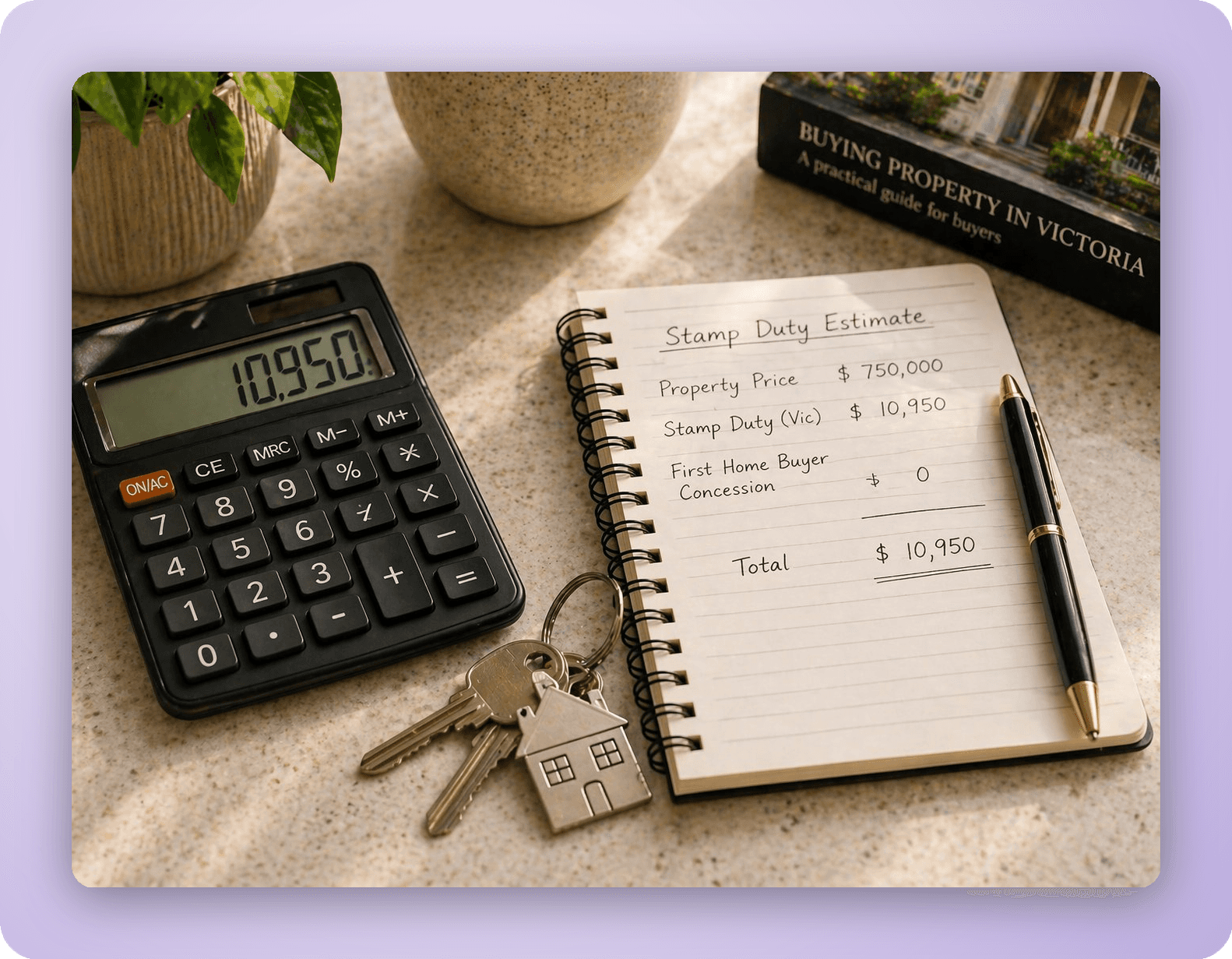
You've saved your deposit, you know what you can borrow, and you've picked a suburb. But have you factored in stamp duty? Officially called land transfer duty, this is the state government tax you pay when you buy property in Victoria, and for most buyers, it's the single biggest additional cost on top of the purchase price.
On a $750,000 home, stamp duty can be upwards of $40,000. On a $1 million property, it climbs higher still. Knowing the number early helps you budget properly and avoid a nasty surprise when your lawyer sends the settlement figures.
How is stamp duty calculated?
Stamp duty in Victoria is calculated on a sliding scale based on the property's purchase price (or market value, if higher). The more the property costs, the higher the percentage you pay. The rates are set by the Duties Act 2000 and assessed by the State Revenue Office (SRO).
The SRO provides an online calculator at sro.vic.gov.au where you can run your expected purchase price and see the exact amount. It's worth doing this early in your property search so you know what you're working with.
What this means in practice: If you're approved to borrow $700,000 and have $80,000 saved, your actual purchasing power isn't $780,000. You need to subtract stamp duty, legal fees, and other costs first. The effective purchase price you can afford is lower than most people initially think.
First home buyer exemptions and concessions
If you're a first home buyer in Victoria, the stamp duty picture improves significantly:
Full exemption: If the property value is $600,000 or less, eligible first home buyers pay no stamp duty at all. This applies to both new and established homes.
Concession: If the property value is between $600,001 and $750,000, a sliding concession applies. You'll pay a reduced amount, with the concession decreasing as the property value approaches $750,000.
Above $750,000: No first home buyer stamp duty concession applies. You pay the full amount.
To qualify, you must be an Australian citizen or permanent resident, be over 18, have never owned property in Australia before, and intend to live in the property as your principal place of residence for at least 12 continuous months within the first year of settlement.
The First Home Owner Grant
Separate from the stamp duty concession, there's also the First Home Owner Grant (FHOG), a one-off $10,000 payment for eligible first home buyers purchasing a new home valued up to $750,000. This doesn't apply to established homes, but if you're buying a new build, it's a meaningful boost.
Off-the-plan concessions
If you're buying an apartment or townhouse off the plan, you may benefit from a concession that allows you to deduct post-contract construction costs from the dutiable value. In practical terms, you pay stamp duty on the land value and any construction completed at the time of contract, not the finished product price.
This temporary concession has been extended several times and currently applies to contracts entered into on or before 20 October 2026, following the passage of the State Taxation Acts Amendment Act 2025. Given its temporary nature, it's worth confirming the current end date with the SRO or your lawyer if you're considering an off-the-plan purchase.
When is stamp duty paid?
In Victoria, stamp duty is paid at settlement through PEXA. Your lawyer calculates the amount, and it's deducted from the settlement funds electronically. You don't need to separately visit the SRO or make a manual payment – it's all handled as part of the settlement process.
However, you do need to have the funds available as part of your overall settlement amount. If you're borrowing, your lender may or may not include stamp duty in the loan – this depends on your loan-to-value ratio and the lender's policies. Check with your broker early.
Other costs to budget for
While you're planning for stamp duty, it's worth building a complete picture of the additional costs of buying property in Victoria:
Legal fees and disbursements – your lawyer's professional fees plus out-of-pocket costs like title searches, PEXA fees, and registration costs. These typically range from $1,000 to $3,000 depending on the complexity of your purchase.
Building and pest inspections – usually $400 to $800. Essential if you're buying at auction where you can't make the contract conditional on the inspection.
Loan application and mortgage fees – your lender may charge application fees, valuation fees, and ongoing account fees. These vary by lender.
Moving costs – often forgotten in the budgeting process, but they add up.
Council rates and owners corporation fees – you'll start paying these from settlement. Check the statement of adjustments to see what's been prepaid by the vendor.
A quick budgeting example
Say you're buying a home for $700,000 as a first home buyer:
Stamp duty: Approximately $24,713 (as at April 2026). This is a reduced amount under the first home buyer concession.
Legal fees: Approximately $1,000–$3,000
Building inspection: Approximately $500 (per property that you inspect)
Loan costs: Varies by lender
Total additional costs: Likely in the range of $30,000 on top of your deposit
If you're not a first home buyer purchasing at $700,000, stamp duty alone could be around $37,000 – a very different number.
How Nextstep Legal helps with budgeting
When we review a contract at NextStep Legal, we don't just check the legal clauses – we help you understand the full financial picture, including stamp duty. We'll flag whether you qualify for exemptions or concessions, estimate the duty payable, and make sure your settlement funds are calculated correctly.
Planning to buy in Victoria? Get a free contract review from Nextstep Legal. We'll walk you through the costs, including stamp duty, so you can budget with confidence.
This article provides general information about Victorian property law. It's not a substitute for legal advice on your specific situation. If you'd like to discuss your circumstances, get in touch.
Stay informed with the latest guides and news.