Conveyancing jargon decoded: a plain-English glossary
6
min read
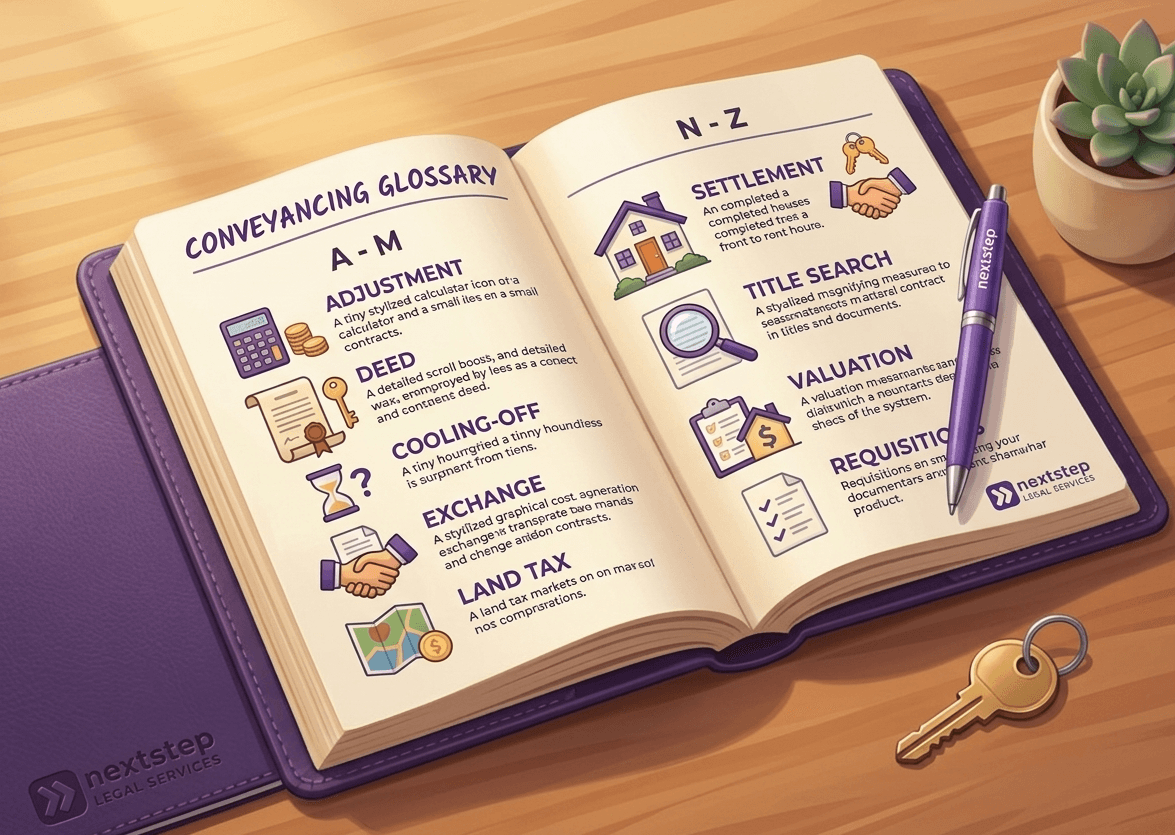
Buying or selling property in Victoria comes with its own language. Your lawyer will try to speak plainly, but some terms are unavoidable – they're baked into the contracts, the legislation, and the process. This glossary covers the words and phrases you're most likely to encounter, explained without the legalese.
Bookmark this page. You'll probably come back to it.
A-C
Adjustment date – the date used to calculate how property expenses (rates, land tax, owners corporation fees) are split between buyer and seller. Usually the settlement date. See our full guide to the statement of adjustments.
Body corporate – see Owners corporation.
Caveat – a formal warning registered on a property's title that tells the world someone claims an interest in that land. A caveat can prevent the property from being sold or transferred until the claim is resolved. Common examples include caveats lodged by unpaid builders or by a spouse in a family law dispute.
Certificate of title – the official record of who owns a piece of land in Victoria. Most titles are now held electronically by Land Use Victoria, but the certificate of title remains the definitive record of ownership, encumbrances, and registered interests.
Conditions precedent – conditions that must be satisfied before the contract becomes binding. The most common example is a subject to finance clause, where the contract is conditional on the buyer getting loan approval.
Contract of sale – the legally binding agreement between the vendor (seller) and purchaser (buyer) that sets out the terms of a property transaction. In Victoria, this includes the particulars of sale, general conditions, special conditions, and the Section 32 vendor statement.
Cooling-off period – a three-clear-business-day window after signing a private sale contract during which the buyer can withdraw. The buyer forfeits $100 or 0.2% of the purchase price (whichever is greater), not the full deposit. There is no cooling-off period for auction purchases or if the buyer obtains a Section 31 certificate from their lawyer. This right comes from Section 31 of the Sale of Land Act 1962. Read more.
Covenant – a restriction registered on the title that limits what can be done with the property. Restrictive covenants might prevent you from building above a certain height, running a business from the property, or subdividing the land.
D-F
Deposit – the upfront payment made by the buyer when signing the contract, typically 10% of the purchase price. The deposit is usually held in a trust account until settlement. It can be paid as a full amount or in part (for example, a smaller amount on signing with the balance due later).
Disbursements – out-of-pocket costs your lawyer pays on your behalf during the conveyancing process. These include title searches, certificate fees, PEXA fees, and registration costs. Disbursements are separate from your lawyer's professional fees.
Easement – a right that someone other than the owner has over the property. Common easements include drainage easements (allowing water authority pipes to run under the land) and access easements (giving a neighbour the right to cross the property). Easements are shown on the title plan and the Section 32.
Expression of interest (EOI) – a method of sale where buyers submit offers by a deadline, rather than bidding at auction or negotiating a fixed price. The vendor is not obliged to accept any offer.
First Home Owner Grant (FHOG) – a $10,000 grant available to eligible first home buyers in Victoria purchasing a new home valued up to $750,000. This is separate from the stamp duty exemption and concession.
G-L
General conditions – the standard terms printed in every Victorian contract of sale, published by the Law Institute of Victoria and the Real Estate Institute of Victoria. These cover things like deposit handling, the cooling-off period, settlement obligations, and default. The current edition was released in September 2025.
Instrument of transfer – see Transfer of land.
Land tax – an annual tax levied by the State Revenue Office on the total taxable value of all land you own in Victoria (excluding your principal place of residence). If you're buying an investment property, land tax is something to factor into your ongoing costs. Since 1 January 2024, vendors are prohibited from passing land tax costs to purchasers at settlement for contracts with a sale price below the threshold amount ($10.7 million for 2026, indexed annually to CPI).
Land Use Victoria (LUV) – the Victorian government body that manages the land titles register. When ownership of a property changes, Land Use Victoria officially records the new owner.
Lender – the bank or financial institution providing the mortgage. The lender is a party to settlement because they provide the purchase funds and register a mortgage over the property as security.
M-P
Mortgage – a legal charge registered over the property title as security for a loan. If the borrower defaults, the lender can sell the property to recover the debt. When you pay off the loan, the mortgage is "discharged" (removed from the title).
Owners corporation (OC) – the legal entity that manages common property in a multi-unit development (apartments, townhouses, units). The OC collects fees from lot owners to maintain shared areas like lobbies, gardens, driveways, and lifts. Also called "body corporate" in everyday language.
Owners corporation certificate – a document obtained from the OC that shows fees owing, any special levies, insurance details, and whether there are any disputes or planned works. Your lawyer orders this as part of the pre-settlement process.
Particulars of sale – the front pages of the contract of sale that set out the key details: the property address, the price, the deposit, the settlement date, and whether the sale is vacant possession or subject to tenancy.
PEXA – Property Exchange Australia. The digital platform used for electronic property settlements in Victoria. Your lawyer uses PEXA to lodge documents and transfer funds electronically on settlement day, replacing the old paper-based process.
R-S
Registration – the act of officially recording a change of ownership (or a mortgage, caveat, or other dealing) on the land titles register maintained by Land Use Victoria. Until registration occurs, the transfer isn't legally complete.
Section 27 statement – a written request from the vendor to the purchaser (under Section 27 of the Sale of Land Act 1962) asking for the early release of the deposit before settlement. The purchaser can refuse.
Section 32 (vendor statement) – a disclosure document the vendor must provide to the buyer before the contract is signed. Required under Section 32 of the Sale of Land Act 1962, it includes information about the title, zoning, building permits, owners corporation details, and anything else that might affect the buyer's decision. Read our full guide to the Section 32.
Settlement – the day ownership officially transfers from vendor to purchaser. The purchaser (or their lender) pays the balance of the purchase price, documents are lodged electronically through PEXA, and the title is registered in the purchaser's name. In Victoria, settlement typically occurs 30, 60, or 90 days after signing the contract.
Settlement agent – a person or firm that manages the administrative and financial aspects of settlement. In Victoria, your lawyer usually handles this directly rather than using a separate settlement agent.
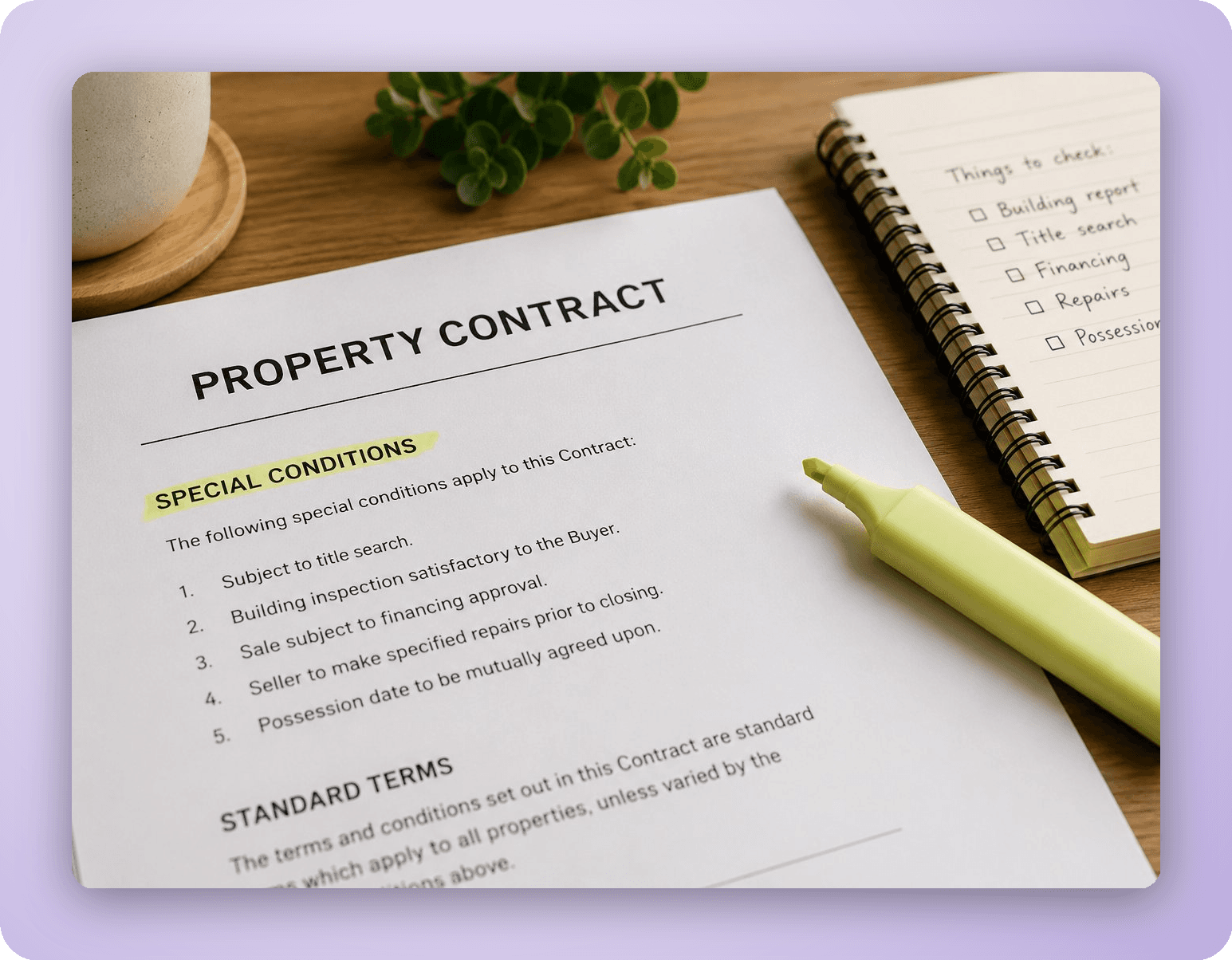
Special conditions – additional terms added to the contract that go beyond the standard general conditions. Common special conditions include a subject to finance clause, a building inspection clause, or a condition requiring the vendor to complete specific repairs.
Stamp duty (land transfer duty) – a state government tax paid by the buyer when purchasing property in Victoria. The amount depends on the property's value, with exemptions and concessions available for first home buyers. Officially called "land transfer duty" under the Duties Act 2000.
T-V
Title search – a search of the Land Use Victoria register that shows the current registered owner, any mortgages, caveats, easements, and covenants on the property. Your lawyer conducts a title search early in the process and again just before settlement.
Transfer of land – the legal document that transfers ownership of a property from the vendor to the purchaser. In Victoria, this is prepared by the purchaser's lawyer, signed by both parties (or their lawyers via PEXA), and lodged with Land Use Victoria at settlement.
Vendor statement – see Section 32. Read our full guide here.
Verification of identity (VOI) – the process of verifying that you are who you say you are before any documents are lodged on the land titles register. Required under the Transfer of Land Act 1958 and the ARNECC Model Participation Rules. Your lawyer will arrange a VOI interview as part of the conveyancing process.
Still confused by a term?
If you've come across a word in your contract or correspondence that isn't covered here, ask your lawyer. There's no such thing as a silly question when you're buying or selling property, and the answer is almost always simpler than the jargon suggests.
Getting a contract reviewed? Nextstep Legal offers free same-day contract reviews for Victorian buyers. We explain every clause in plain English so you know exactly what you're signing.
This article provides general information about Victorian property law. It's not a substitute for legal advice on your specific situation. If you'd like to discuss your circumstances, get in touch.
Stay informed with the latest guides and news.