First home buyer checklist: your complete Victorian guide
6
min read

Buying your first home in Victoria is exciting, and also one of the biggest financial and legal commitments you'll ever make. There are grants to claim, concessions to apply for, contracts to review, and a settlement process that can feel like it was designed by someone who enjoys acronyms. This checklist walks you through it, in the order things actually happen.
If you do nothing else, bookmark this page and work through it in sequence. Each step links to a deeper guide where it helps.
1. Work out what you can actually spend
Before you look at a single listing, get your numbers straight. "What the bank will lend you" and "what you can comfortably repay" are rarely the same figure.
You'll want to budget for:
Deposit: typically 5% to 20% of the purchase price
Stamp duty (see step 3) if your purchase falls outside the exemption
Lenders Mortgage Insurance (LMI) if your deposit is under 20% and you're not using a government guarantee scheme
Legal fees for your contract review and conveyancing
Building and pest inspections, usually $400 to $700
Loan application and settlement fees
Moving, connection, and immediate repair costs
A realistic rule of thumb: on top of your deposit, set aside another 4% to 6% of the purchase price for costs. First home buyers often underestimate this and end up short at settlement.
2. Check if you qualify for the First Home Owner Grant
The First Home Owner Grant (FHOG) in Victoria is a $10,000 payment for eligible first home buyers, but only for brand-new homes. It's not available for established properties.
To qualify for the FHOG in Victoria, broadly speaking:
The home must be new: never previously sold, occupied, or lived in
The property value must be $750,000 or less
You (and your spouse or partner) must not have previously owned residential property in Australia, or if you did, you must not have lived in it
At least one applicant must be an Australian citizen or permanent resident
You must move in within 12 months of settlement and live there for at least 12 continuous months
The FHOG is administered by the State Revenue Office of Victoria. Most people apply through their lender at settlement rather than directly to the SRO.
If you're buying an established home, you can't get the FHOG, but you may still qualify for a stamp duty exemption or concession, which is usually the bigger saving anyway.
3. Understand stamp duty and the first home buyer exemption
Stamp duty (technically, land transfer duty) is often the largest single cost after the deposit. The good news: first home buyers in Victoria get a significant break.
The current first home buyer duty rules in Victoria are:
Dutiable value up to $600,000: full exemption, no stamp duty payable
Dutiable value $600,001 to $750,000: a concession on a sliding scale, with the concession phasing out at $750,000
Dutiable value above $750,000: no first home buyer concession, full duty payable
To qualify, you must use the home as your principal place of residence for a continuous period of at least 12 months, starting within 12 months of settlement. The exemption applies whether you're buying an established home, a new build, or vacant land to build on.
These thresholds have not moved in years, so in hotter parts of Melbourne they rule out a lot of stock. If you're buying close to $750,000, a small shift in price can make a meaningful difference to your duty bill. This is worth modelling carefully with your lawyer before you sign.
For a deeper walkthrough of how duty is calculated, see our guide to stamp duty in Victoria.
The off-the-plan duty concession
If you're buying an apartment or townhouse off the plan, there's a separate, temporary concession that lets you pay duty only on the land value plus any construction completed at the contract date, which is often a much lower figure than the purchase price. This concession currently applies to contracts signed between 21 October 2024 and 20 October 2026. It has been extended before, but don't assume it will be again.
4. Consider the 5% deposit scheme
The Australian Government's 5% Deposit Scheme (formerly the First Home Guarantee) lets eligible first home buyers purchase with a 5% deposit without paying LMI. The government guarantees the remaining 15%, so lenders treat it like a 20% deposit loan.
From 1 October 2025, the scheme was significantly expanded: income caps were removed, the annual cap on places was removed, and property price caps were lifted. For Victoria, the current property price caps are:
Melbourne and Geelong: $950,000
Rest of Victoria: $650,000
You apply through a participating lender, not directly to Housing Australia. The scheme stacks with the stamp duty exemption and, if you're buying new, the FHOG.
5. Do your pre-purchase homework
Once you're ready to start looking seriously, shift into due diligence mode. Before you put in an offer or bid at auction, you should:
Read the Section 32 Vendor Statement for every property you're seriously interested in. This is the document the vendor must give you before you sign, under section 32 of the Sale of Land Act 1962 (Vic). It contains title information, planning details, rates, outgoings, and any restrictions. Our guide to the Section 32 explains what to look for.
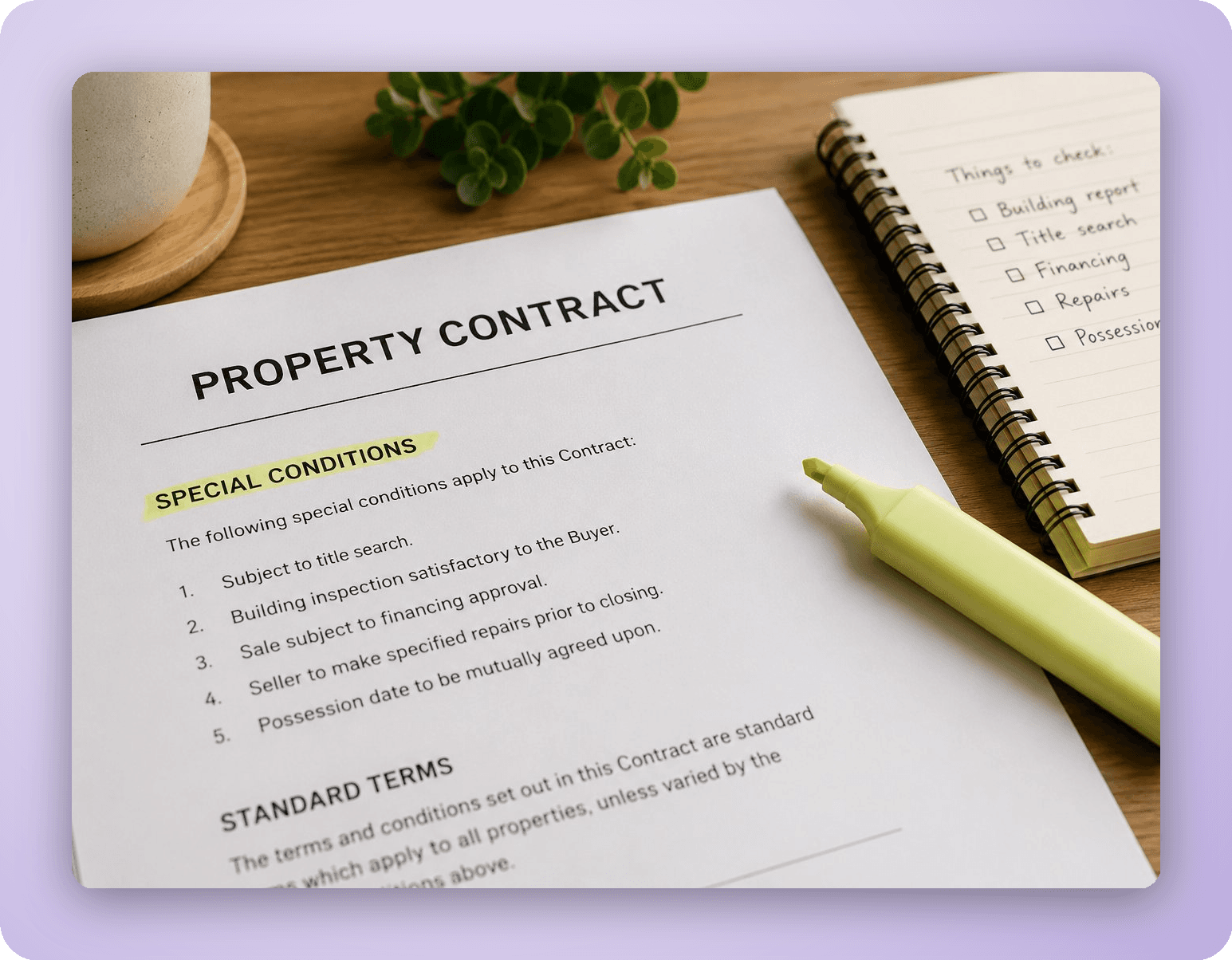
Read the Contract of Sale alongside it. Check the price, deposit, settlement date, and any special conditions.
Book a building and pest inspection for anything you're serious about.
If you're buying at auction, do this work before auction day. There's no cooling-off period when you buy at auction, so once the hammer falls, you're locked in. See our pre-auction due diligence guide for the full list.
This is the part where most first home buyers start to worry they'll miss something. That's reasonable, because there's a lot to miss. A lawyer's review of the Section 32 and contract is inexpensive insurance against a very expensive mistake.
6. Get the contract reviewed before you sign
Before you sign anything or bid at auction, have the Contract of Sale and Section 32 reviewed by a lawyer. A good review will:
Flag anything unusual or risky in the contract (short settlement, unusual special conditions, restrictive covenants, planning overlays)
Confirm the property is what the vendor says it is
Check finance and inspection clauses are drafted correctly if you're buying by private sale
Explain your cooling-off rights if you're buying privately
Nextstep Legal offers free same-day contract reviews for Victorian buyers. If you're weeks away from bidding, get in early so we can turn around multiple properties.
7. Know your cooling-off rights (private sales only)
If you buy by private sale in Victoria, you generally have a three business day cooling-off period after signing the contract, during which you can pull out. There are several exceptions, including auction sales, within three clear business days before or after a publicly advertised auction, and purchases over a specified threshold. See our cooling-off period guide for the detail.
If you cool off, you forfeit a penalty (the greater of $100 or 0.2% of the purchase price), but you get the rest of your deposit back.
8. From contract to settlement
Once the contract is signed and any cooling-off period has passed, your lawyer takes over the heavy lifting. They'll:
Order title searches and check for any last-minute issues
Prepare the transfer of land and related documents
Verify your identity (VOI), which is a legal requirement under the national electronic conveyancing rules
Prepare a Statement of Adjustments to work out who pays what for council rates, water, and owners corporation fees at settlement
Lodge everything on PEXA and settle the transaction electronically
For a plain-English walkthrough of what happens between signing the contract and getting the keys, read our guide to what happens after you sign.
9. Settlement day and after
On settlement day, funds move through PEXA, the title transfers into your name, and your lender registers its mortgage. Your lawyer will confirm settlement has happened, and the real estate agent will release the keys.
After settlement:
Keep copies of your settlement statement and lodgement confirmation
Update your address with Medicare, the electoral roll, and your super fund
Remember the 12 month residence requirement for the stamp duty exemption and FHOG
Lodge your FHOG application if your lender hasn't done it for you at settlement
How Nextstep Legal can help
First home buyers are our bread and butter. We review contracts on the same day (usually within a few hours), explain what we find in plain English, and handle your conveyancing from offer through to settlement. Flat fees, no surprises.
Ready to get started? Book a free contract review or request a fixed-fee quote.
Stay informed with the latest guides and news.